Long before LMS platforms and training decks, a system existed that built mastery for centuries. What can we learn from it today?
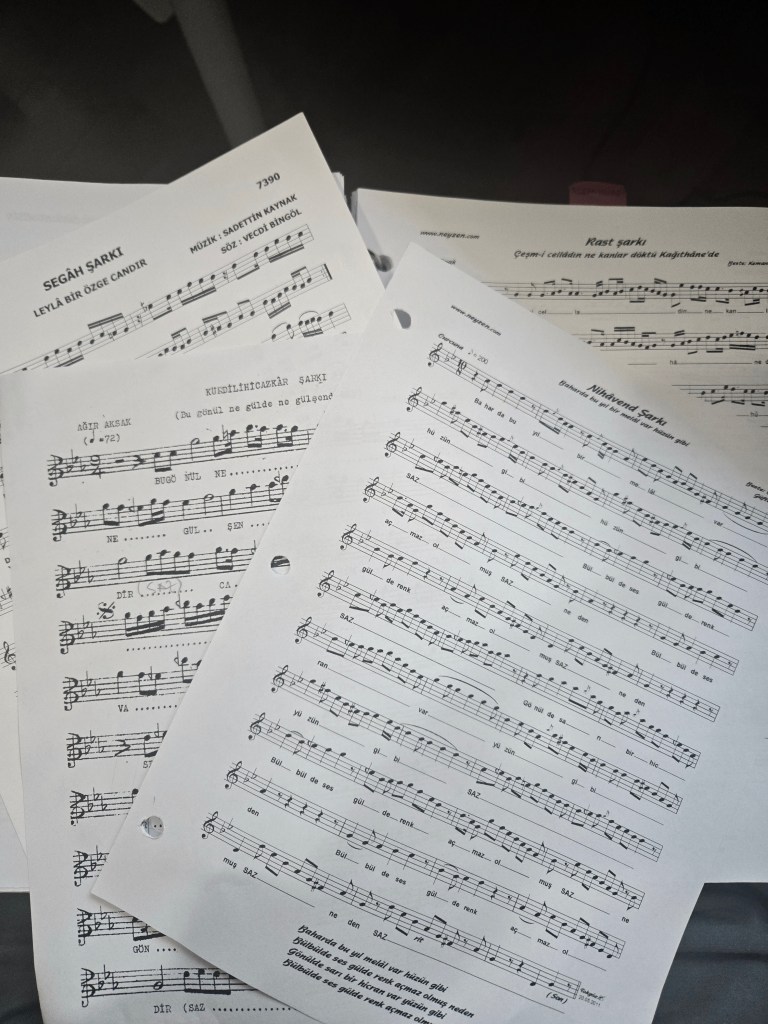
Last year, I joined a Turkish Classical Music choir.
Not to perform. To learn.
They told me I didn’t need to know how to read sheet music!!!
And I stepped into a centuries-old system called meşk (meshk).
Imagine this:
A music room during the Ottoman Empire.
- No slides.
- No manuals.
- A master sings a phrase.
- Students listen.
- They repeat.
The master stops them not to explain, but to refine:
- a subtle tone
- a slight hesitation
- a missing feeling
They try again and again.
This is the meşk (meshk) system.
Built on:
- listening deeply
- repeating consistently
- receiving immediate feedback
- learning in the moment
- and eventually… adding your own interpretation
Because the goal is not to copy.
“The ‘tavır’ (interpretive style) and ‘üslup’ (expression) in Turkish music contain microtonal and rhythmic nuances that cannot be captured through notation. A master’s subtle vibrato in the breath, or the gliding approach to a pitch (glissando), becomes mechanical the moment it is put on paper. For this reason, traditional musicians believed that notation imprisons the soul of a piece on paper and in doing so, kills it.”
— Adapted from Murat Karabulut
It’s to internalize and transform.
For centuries, entire musical traditions survived this way.
Not because they were documented perfectly but because they were experienced, practiced, and passed through people.
Now pause…And look at how we design learning in organizations.
We:
- extract expertise
- turn it into content
- standardize it
- scale it
And expect it to stick.
But what quietly gets lost?
- judgment
- timing
- nuance
- confidence in action
- the ability to adapt in real situations
In short… real capability.
This is where SME-led learning becomes critical.
Because some skills cannot be built through content alone:
- leading through ambiguity
- navigating complex customer interactions
- making high-stakes decisions
- developing craft and professional intuition
These require:
- observation
- guided practice
- real-time correction
- repetition in context
Exactly what meşk was designed for.
The system worked because it focused on:
- retention through repetition
- learning through doing
- constant, timely feedback
- and space for the learner to make it their own
So here’s the real question:
Where are we over-relying on content… when we should be designing for experience?
Because if a system like this sustained mastery for centuries…it’s worth asking:
What are we missing by only transferring information today?

