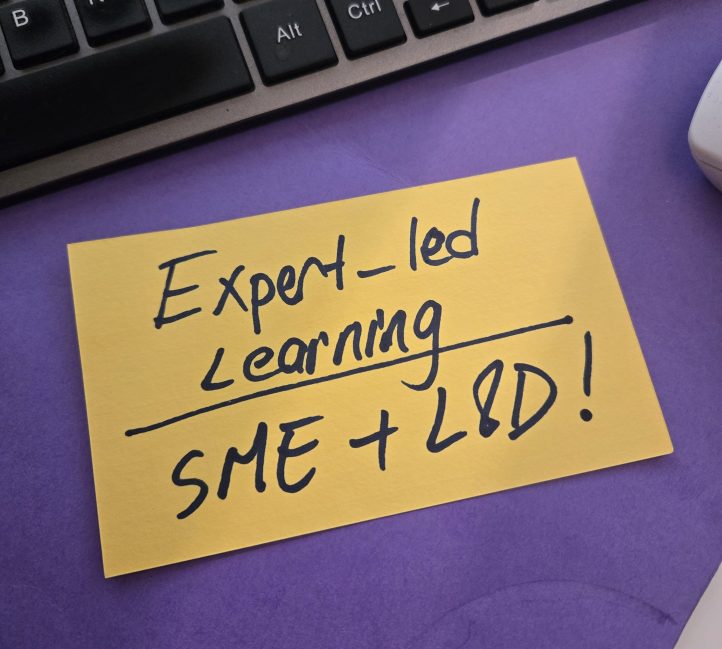
“Many organizations rely on subject matter experts (SMEs) to deliver training, yet expert-led training does not automatically translate into real learning.”
Organizations today are sitting on an enormous learning resource; their own people.
Across industries, companies are realizing that the most valuable knowledge often lives inside the organization: in experienced engineers, senior consultants, product specialists, and operational leaders who have accumulated years of insight and practical judgment.
Yet there is a persistent gap between expertise and learning. Many organizations rely on expert-led training, but expertise alone does not guarantee learning.
Just because someone knows something deeply does not automatically mean they can transfer that knowledge effectively to others. For decades, the traditional model attempted to solve this gap through a clear division of roles. SMEs provided the knowledge, and Learning & Development teams transformed that knowledge into training programs.
This model worked reasonably well when knowledge changed slowly and training cycles could afford to take months. But the environment organizations operate in today is different. Knowledge evolves faster. Skills become outdated more quickly. Organizations are increasingly shifting toward skills-based models, where the ability to continuously develop and redeploy skills becomes a strategic advantage.
In this environment, the traditional model of knowledge transfer often struggles to keep pace.
The Rise of Expert-Led Learning
A growing trend in corporate learning is the move toward expert-led learning.
Instead of relying solely on centralized program design, organizations are beginning to leverage their internal experts more directly in the learning process (Googler-to-Googler learning: around 80% of Google training is delivered through an employee to employee network called g2g).
Engineers teach engineers. Product specialists train sales teams. Experienced leaders share frameworks and decision models with the next generation of talent.This shift makes sense for several reasons.
- Internal experts bring contextual knowledge that external training often lacks. They understand the systems, the culture, and the real problems employees face every day.
- Expert-led learning allows organizations to respond faster to emerging needs. When knowledge sits within teams, the transfer of that knowledge does not need to wait for long design cycles.
- Expert-led learning supports the evolution toward skills-based organizations, where learning becomes continuous and embedded in daily work.
However, expert-led learning also exposes an important challenge. Expertise does not automatically translate into effective learning experiences.
The Hidden Bottleneck in Knowledge Transfer
Many organizations have experienced this situation. A highly knowledgeable expert is asked to “train others.” They prepare a detailed presentation filled with valuable information. The session is delivered. Participants listen.But when the session ends, little actually changes in how people work.
This happens because information transfer is not the same as learning. Learning requires structure, engagement, reflection, and opportunities for application. Without these elements, even the most valuable knowledge can remain inaccessible. This is where Learning & Development teams traditionally step in. Without learning design, expert-led training often becomes information sharing rather than skill development.
Yet L&D teams often face their own constraints. They cannot possibly design every learning experience across the organization. The volume of knowledge that needs to be shared is simply too large.
What organizations increasingly need is not just more programs, but a different model of knowledge transfer.
Turning Expert-Led Training into Real Learning
One promising approach is to rethink the relationship between subject-matter experts and Learning & Development teams.
A New Partnership Between SMEs and L&D
One promising approach is to rethink the relationship between subject-matter experts and Learning & Development teams.
Rather than expecting L&D to carry the entire design workload, organizations can equip SMEs with foundational learning design capabilities.
This does not mean turning every expert into an instructional designer.
Instead, it means helping experts learn how to:
- clarify the learning outcome behind their expertise
- structure their knowledge into meaningful learning flows
- engage participants through discussion and application
- facilitate learning rather than simply present information
In this model, L&D continues to play a critical strategic role. They provide the learning frameworks, quality standards, and evaluation methods that ensure learning initiatives align with organizational goals.
SMEs, meanwhile, become more effective partners in the learning process, capable of structuring and sharing their expertise in ways that support real skill development.
This distributed approach allows organizations to scale learning far more effectively than traditional models.
The Strategic Benefits for L&D
Far from replacing Learning & Development, this approach actually strengthens the strategic role of L&D.
When SMEs are equipped to contribute more effectively to learning design, L&D teams can shift their focus toward higher-value activities such as:
- aligning learning with business strategy
- identifying emerging skill needs
- designing learning ecosystems rather than individual courses
- measuring impact and capability development
In other words, L&D moves from being primarily content creators to becoming architects of organizational learning.
This shift is particularly important as organizations navigate rapid technological change, AI integration, and evolving workforce expectations.
From Expertise to Impact
This perspective has shaped much of the work I’ve been exploring through my own practice.
For many professionals and organizations, the challenge is not a lack of expertise. The challenge is transforming expertise into meaningful learning experiences that create real change. My approach focuses on bridging that gap.
It starts with a simple premise: knowledge becomes valuable only when it can be transferred in ways that help others think differently, act differently, or perform differently.
Helping experts structure their knowledge, design learning experiences, and facilitate meaningful conversations is a critical part of that process.
When organizations succeed in unlocking the learning potential of their own experts, something important happens. Knowledge begins to move more freely. Skills develop more quickly. And learning becomes embedded in the culture of the organization rather than confined to formal training programs.
Learning as a Strategic Capability
The organizations that thrive in the coming years will not necessarily be those with the most content or the largest course libraries. They will be the organizations that learn fastest.
Leveraging internal expertise, empowering subject-matter experts, and strengthening the partnership between SMEs and Learning & Development teams are all part of building that capability.
When expertise is intentionally structured and shared, learning becomes more than an activity. It becomes a strategic advantage.
 Lifelong Learner