
Many years ago, I had the opportunity to implement a blended version of Charles Allen and Rodney Peyton’s 4-Step Process to teach procedural and technical skills in manufacturing through on-the-job training. The results with the pilot group were extraordinary. The time required to teach a complicated process was reduced to almost half of what it was before. Human errors decreased significantly, almost to zero. The calculated Return on Investment (ROI) by industrial engineers was remarkable.
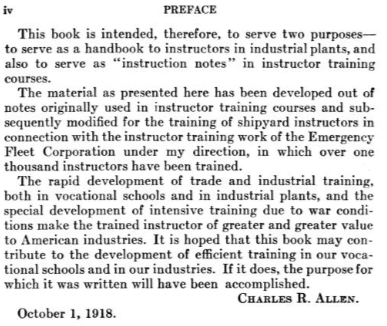
In manufacturing and healthcare, these kinds of methods are highly valued because they are tasked with teaching complex technical procedures. Allen developed the 4-step process in the early ’10s, which was used to train shipyard instructors. In the late ’90s, Rodney Peyton’s 4-Stage Approach started gaining popularity in healthcare education.
You might be familiar with terms like the “Say one- Do one- Teach one” method. Both Allen and Peyton follow the same logic.
They both have 4-step methodologies:
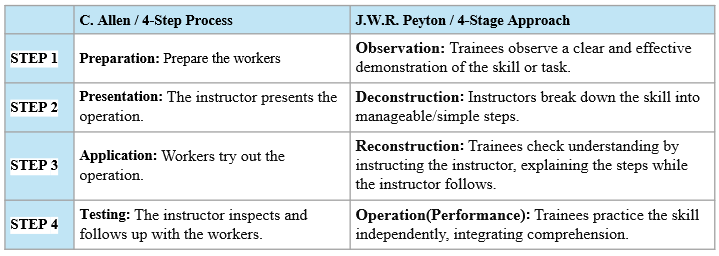
Allen used this method to train shipyard workers, while Peyton developed a similar approach with a critical emphasis on Deconstruction. Both approaches highlight the importance of the trainees’ skills and comprehension levels before training and emphasize feedback as a crucial component. Today, Training Within Industry (TWI) employs these methods to standardize work. Healthcare education continually seeks to improve teaching techniques to assist healthcare professionals. Both industries are critical; human error is not acceptable in operational settings. For both, it can be a matter of life and death, whether building a car or performing open-heart surgery. Hence, effective methods are crucial for teaching complex technical procedures.
As a trained engineer, I’m fascinated by these kinds of methodological approaches. Formulas, step-by-step techniques, and problem-solving methods are areas I enjoy exploring. When I transitioned into a performance development professional, I delved into structured definitions of how we learn and how we should teach. I thought that there should be a formula for everything. There are enough educational theories that have great structures which I love to follow as fundamentals.
And yet, it is still challenging to teach or learn skills like Active Listening, Empathy, Leadership, Conflict Resolution, and Creativity, remain challenging to teach or learn effectively. Which is affecting our quality of life. Effective learning theories exist, but the high human error rate in these areas leading to significant consequences, even wars. The complexity of human beings, the unknowns about our brains, and the multitude of factors affecting our behaviors make achieving zero human error in these areas challenging.
Can we create a 4, 5, or even a 100-step approach to teach people to become better versions of themselves, resulting in zero human error? This question remains open, inviting continuous exploration and innovation in training methodologies. It is worth it to work towards zero errors and maximize human potential in every aspect of life.
Resources
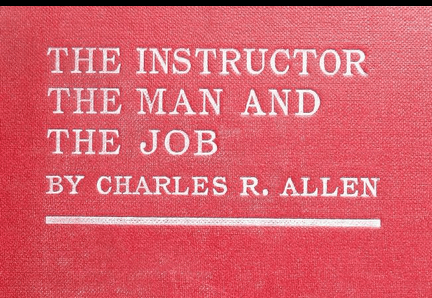
Allen, C. R. (1919). The Instructor, the Man and the Job: A Handbook for Instructors of Industrial and Vocational Subjects. Philadelphia and London: J. B. Lippincott Company.
Peyton, J. W. R. (Ed.). (1998). Teaching & Learning in Medical Practice. Heronsgate Rickmansworth, Herts.: Manticore Europe Ltd.
Roots of Lean. (n.d.). Retrieved from http://www.lean-promotion.com/RootsofLean.pdf
 Lifelong Learner