Many learning theories explain the aspects of learning, how learning happens, and various kinds of learning needs with different perspectives. To develop a successful learning program, instructors need to know the concepts and applications of different theories. In this post, Bloom’s Taxonomy of Learning is addressed including the major concepts, adult learning applications, and suggested strategies.
Main concepts
In 1956, Bloom introduced a taxonomy to classify learning outcomes, especially to identify behavioral forms of objectives (Bloom, 1956, p.5). He identified three domains of learning – cognitive “which deals with the recall or recognition of knowledge and the development of intellectual abilities and skills”, affective “which describes changes in interest, attitudes, and values, and the development of appreciation and adequate adjustment”, and psychomotor (Bloom, 1956, p. 7).
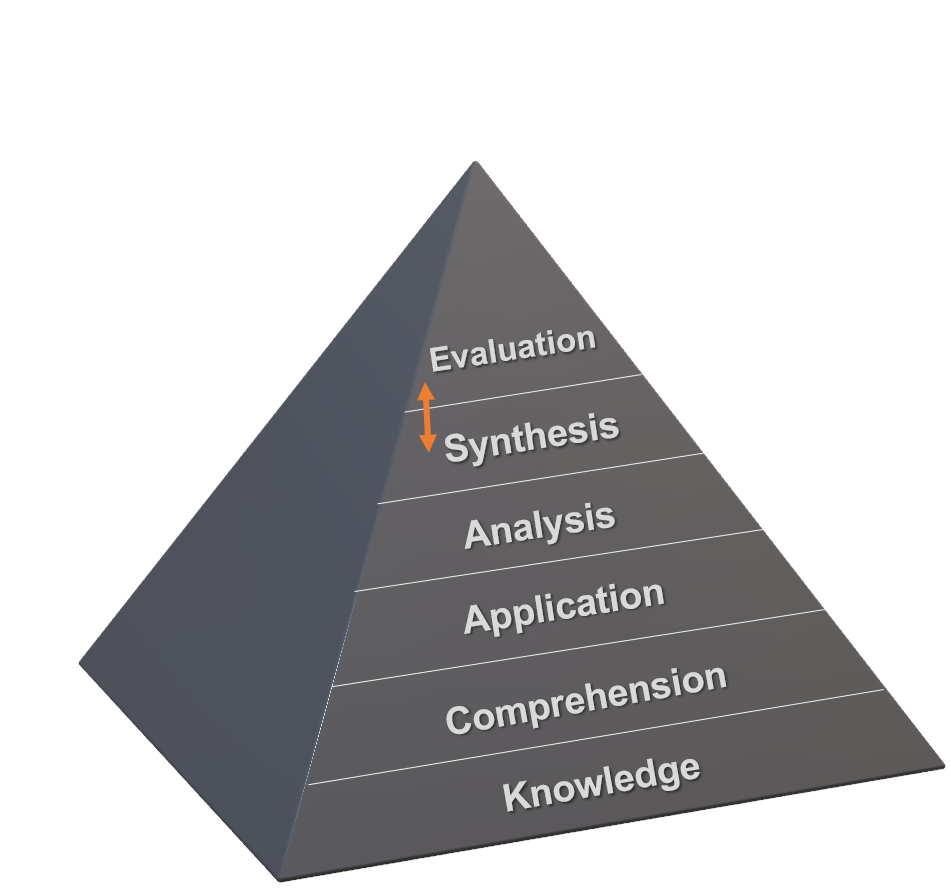
Bloom`s Taxonomy has six major levels (Bloom, 1956, p. 201).
- The lowest level is knowledge, which includes recall of specifics, methods, processes, etc.
- The next level is comprehension, where the level of understanding can be seen
- The third level is defined as the application, which is the use of information in a particular situation
- The fourth level is analysis, which includes analyzing the elements of information
- The next level is defined as synthesis, which refers to putting the information elements together in a different way to construct a new form
- The higher level is evaluation where learners have judgments about the value of the information for the given purpose.
Adult Learning Applications
Bloom’s Taxonomy is used as a guide to define clear learning objectives as a description of learners’ behavior which is essential during curriculum development (Merriam & Bierema, 2014, p. 34-35). The outcomes are defined for different levels of learning domains and this helps instructors to design their program to meet clear goals.
Using Bloom’s Taxonomy is also beneficial for the evaluation process. Deciding how, what, and when to measure becomes easier for instructors when outcomes are set according to Bloom’s Taxonomy.
Using Bloom’s taxonomy is also beneficial for the evaluation process. Deciding how, what, and when to measure becomes easy for the instructor when the outcomes are set according to Bloom’s Taxonomy.
Strategies
Bloom’s Taxonomy is a great guide to address different levels of learning in program development. Starting from covering lower levels of learning needs and building the program up to higher cognitive levels helps learners adopt the content successfully. For example, the program begins with defining a theory. Then, the instructor explains its structure and characteristics, and learners discuss their understanding. Subsequently, learners solve a problem using the theory, compare it with other theories, and argue why they would or would not consider using the theory over a case. Finally, they prepare a project in which they use the theory to build a strategy.
In addition to the program design strategy above, the evaluation strategy could be structured according to Bloom’s Taxonomy. Instructors could use the taxonomy to evaluate all levels of learning. In this case, the lower levels of learning might carry lower weight than higher cognitive levels. For instance, a question about the definition might receive lower points, whereas the application of the content and suggestions for a strategy might receive higher points.
References
Bloom, B.S. (Ed.). Engelhart, M.D., Furst, E.J., Hill, W.H., Krathwohl, D.R. (1956). Taxonomy of Educational Objectives, Handbook I: The Cognitive Domain. New York: David McKay Co Inc.
Merriam, S.B. and Bierema, L.L. (2014). Adult Learning: Linking Theory and Practice. Wiley Brand Kindle Edition.
 Lifelong Learner